Where Two Worlds Meet
The medicine wheel or sacred hoop has been used for generations by different cultures but specifically by American Indians to facilitate change and transformation. The wheel or hoop can be used to facilitate healing and to seek direction not only upon our physical path through life, but also upon our spiritual path through this life. A medicine wheel can be made outdoors by selecting twelve stones (although you can also use four stones) to create a circle. You enter and leave the circle from the east side, the side that represents the road or doorway into the spiritual realm. When you have entered and blessed the wheel, when you have called in the spirit allies or ancestors, the medicine wheel is then closed by placing the last stone. You are then ready to work the wheel.
The medicine wheel is an important concept to every shaman. As the community’s primary connection to the spiritual world, or the community’s axis mundi, the shaman is required to go through arduous training, learning to move and operate effectively between the worlds. The shaman learns to speak to the plants, dance for rain, make plant medicine and find the buffalo. (S)he journeys on behalf of her patients to ask the spirits to heal their bodies and to acquire knowledge. They are often seen as the doctor, counselor, healer and leader. Shamans are well respected guides who help members of their community to navigate through life, from birth to death to beyond the grave. They are there to help in the physical world and the spiritual world; in dealing with the day to day problems of living as well as the sacred. To be considered a shaman is an honour. It is a recognition of your hard work, your devotion, your commitment and your compassion. When you truly live and work as a shaman, you live as Christ, as a servant for those who follow and trust you.
The cornerstone of the shaman’s profession is the journey. The ability to journey or travel into the spiritual dimension to work directly with compassionate spirits is what sets the shaman apart from other kinds of healers and medicine people. If we go back to the Jacob’s Ladder parable we will remember that Jacob had been sent on a journey by God, but not only was the message of the journey apparent in the physical, but also in the spiritual for his dream also spoke to him about journeying. The whole dream was a message about taking a spiritual journey and finding the Lord, or God, at the end of it. This clearly depicts (for me) that we are all called to journey into the spiritual realms of life, but that we are not all ready. The shaman stands in the gap for those who are either not yet called or not yet ready and accesses the information for them. The shaman prepares for his journey as you would any other journey, for there are always things to put in place before you leave home. Many shamans believe that their soul or spirit actually leaves their body while they are journeying and that it voyages to different levels of the spirit realm. This is why you will sometimes hear about the necessity to keep the shaman warm whilst he is journeying due to the drop in body temperature. Many believe that the shaman’s soul or spirit leaves the body but remains intact via a spiritual thread which enables him to return safely to his body.
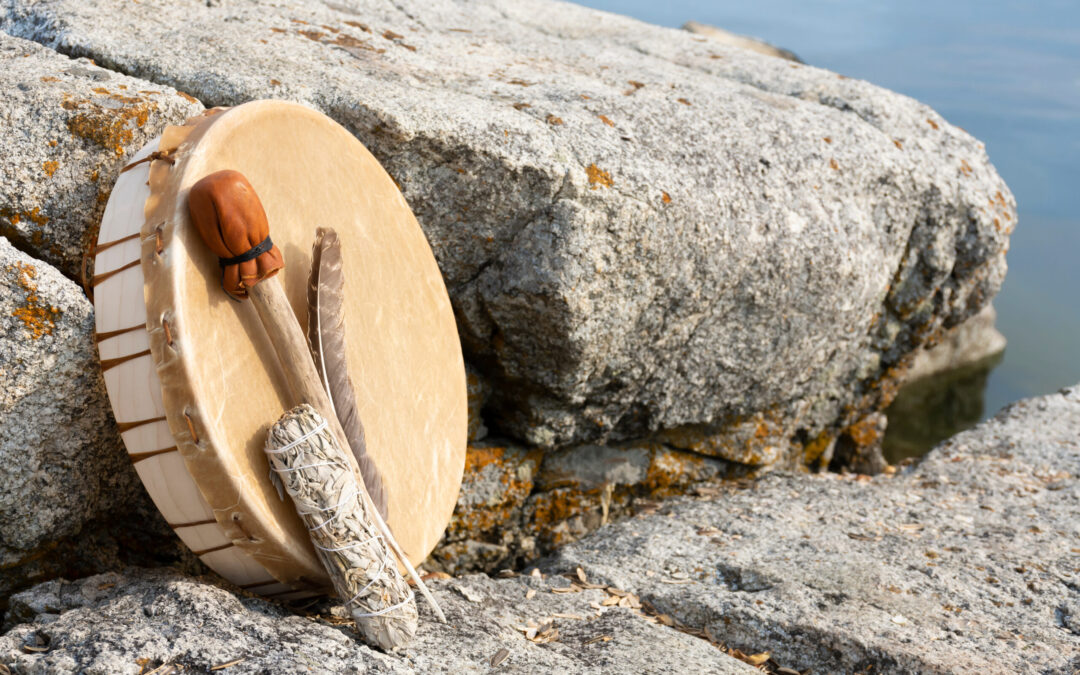
In order to journey, the shaman enters an altered state of consciousness or trance state which we have already discussed. The methods used to enter this state vary between cultures, but typically there is some form of repetitive sound causing a repetitive generating loop. Often this sound is from a helper who sits and drums or uses a rattle. Some cultures are said to sing the shaman into other realms. Whichever method is used, the commonality is a continuous beat or trance generating loop whilst the dreamer, the shaman, sleeps or travels. This continuous rhythm is often called a sonic drive and is said to help push the shaman into the level of consciousness required where she can perceive the spiritual realms and receive a message to bring about healing. The frequency of the sonic drive is similar across cultures, and ranges from four to seven beats per second. This range corresponds with the frequency of an electroencephalogram reading of brain waves recorded in the theta or delta state.
Medscape states: The electroencephalogram (EEG) is the depiction of the electrical activity occurring at the surface of the brain. This activity appears as wave forms of varying frequency. EEG waveforms are generally classified according to their frequency. The most familiar classification uses alpha, beta, theta, and delta. Most waves of 8Hz and higher frequencies are normal on a waking adult.
As spiritual beings made up of vibration and sound, it stands to reason that when we align our vibration with a certain trance state that we will naturally flow into that state. On a larger scale, if we know the frequencies of that which we desire and align our frequency to it, we will become it. Bringing this information together with Jacob’s Ladder gives us a fresh understanding, that as we climb or ascend the ladder to spiritual enlightenment, spiritual knowledge, we change our rate of vibration in alignment with that which we are connecting with, the end product being when we reach the top of the ladder to where it was said the Lord or God, or spiritual enlightenment is, we become that which we have connected with or that which we have synchronized our vibration with.
It is said in physics that kinetic energy is the energy of motion. An object or matter (body) that has motion, whether it is vertical or horizontal, has kinetic energy. There are many forms of kinetic energy – vibrational (the energy due to vibrational motion), rotational (the energy due to rotational motion), and translational (the energy due to motion from one location to another). Kinetic energy is defined as the work needed to accelerate a body of a given mass from rest to its stated velocity. Having gained this energy during its acceleration, the body maintains this kinetic energy unless its speed changes. The same amount of work is done by the body when decelerating from its current speed to a state of rest. Can this be applied to our spiritual life? To journeying?
If we think back to the famous Einstein equation of:
E=mc2
We will remember that (m) matter multiplied by (c) speed of light squared = (E) energy. Why would you need to multiply matter by the speed of light to produce energy? The reason is that energy, be it light waves or radiation, travels at the speed of light. That breaks down to 186,000 miles per second (300,000 kilometres per second). When we split an atom inside a nuclear power plant or an atomic bomb, the resulting energy releases at the speed of light. But why is the speed of light squared? The reason is that kinetic energy, or the energy of motion, is proportional to mass. When you accelerate an object, the kinetic energy increases to the tune of the speed squared.
Could this be why or how shamans are said to be able to journey from one location on earth to another location? Can shamans travel at the speed of light? Could this be what enables the shaman to leave their body and traverse into the spiritual realm? Could this be what enables the shaman to spiritually travel to another persons body in order to bring healing? These are all valid questions.
The notion of a particular repetitive sound to affect the mind we can believe, it is consistent with scientific fact, but what leaves us questioning is whether or not the shaman’s journey is a function of the internal workings of the mind or whether it is an external journey, where (s)he somehow leaves her physical body to traverse a non-ordinary reality, the spiritual realms.
Shamans are said to be able to travel long distances. They can be gone for hours, even a few days, and return with detailed descriptions of places they have not visited in ordinary reality. In many shamanic cultures the ability of the shaman to journey was not just a test of his abilities but was also a survival need for the community. The shaman would journey to find the location of the bison or deer so that on his or her return, she was able to instruct the hunters where to find food.
Once on the shamanic journey, the shaman will meet one or more helping spirits or allies. Some of these spirits she would have already have built a relationship with over the years. The spirits are compassionate and willing and ready to help the shaman bring healing into her own life and the life of others. The spirits can be in many forms; they may be animal, human or even plant, they could be ancestors from generations gone by. But a notable similarity between the traveling shaman and Christianity, and other religions for that matter, is that the shaman appears to not connect directly with God, the Divine Source, but with intermediaries. Christians pray to God through Christ. They don’t tend to pray directly to a God Source, even though Christ is said to be the physical manifestation of God. My suggestion is that once a person either reaches the top of, or near the top of Jacob’s Ladder, they will reach a place where they no longer converse with intermediaries, as their rate of vibration would have attuned itself to the Source, and therefore will have no more need for intermediaries. I believe the intermediaries are there to help people on their personal spiritual quest, but then there will come a point where personal and spiritual transformations have elevated the individual to a different sphere. I believe the top or near the top of Jacob’s Ladder is the starting point, the gateway, the portal into the fourth dimension where God, the Source, abides. We speak more of this later on. However, intermediaries or not, the shaman is careful to show respect and pay tribute to the spirit allies; it is not uncommon for shamans and other medicine people to leave tobacco as way of saying, ‘Thanks.’ It is a well-known fact that when taking or cutting plants, a medicine person or shaman will often give thanks and leave tobacco or some other gift as a sign of respect to the spirits that are helping them. If the spirit is an animal, the shaman may imitate the animal’s movements as a way of communicating to it and showing respect for it. By dancing the animal or imitating its moves, it is said that the shaman calls down or calls in its power and wisdom.
Stephen Larsen’s The Shaman’s Doorway (1998) speaks about the relationship of shamanism to both our psyche and society as a whole. As a psychotherapist with a vast knowledge of shamanic traditions, Larsen shows the relevance of the shamanic path to our modern world. He talks about how Life dismembers us and how ancient shamanic techniques can alter consciousness. He talks about how our demythologized and industrialized environment can and often does lead us to alienation and confusion.
We are The Quantum Warrior, The Master Architect of our life – Braveheart