Herbs, Ceremony & Sound
Plant medicine has been around for thousands of years. Even if you had never heard of shamanism or shamans, you would have heard of plant medicine or herbal medicine. Traditionally, shamans were expected to know their herbs, especially local ones, in order to help the community. Often, this knowledge was passed down from the wise ones, the elders, the previous shaman, and often this knowledge was learnt by the observance of nature, by watching which plants the animals used and when, and at other times the shaman would practise on himself. Plant medicine is also used for its spiritual component, not just its physical ability to heal. It is the indigenous healers’ knowledge of plant medicine that has contributed extensively to the development of modern medicine; that is, orthodox medicine. Plant medicine is one such healing method that orthodox doctors are more readily accepting, probably because it can be tested scientifically, but even now much of the plant world is left in the dark because of lack of scientific evidence.
For years herbal remedies or folk medicine have been used. Slippery elm is well known for helping balance digestive upsets. Valerian is well known for inducing sleep, peppermint for food induced migraines, chamomile to soothe skin irritations, myrrh to heal wounds, frankincense to open spiritual awareness. This is just a handful of uses which doesn’t even scrape the surface of what is available and their healing properties. Plant medicine has been used since the beginning of time. Even the Bible mentions them, and all around the world you will find people with knowledge of plants and knowledge on how to use plants medicinally.
For many, the plant is just a plant, and just as one reaches out for an aspirin without any due thought, so too do some people reach out to plants without any due thought. The plant is treated as a resource to bring relief or healing to a sick or out of balance body. To the shaman, the approach is very different. To start with, the shaman would approach a plant and first ask permission to take it or some of it. If the answer was no, it was not taken, as simple as that. Great care would be taken in the cutting of the plant and ensuring enough was left for the future. This was of great importance. Thanks was given to the plant or bush and often a small offering of tobacco was left. The plant was treated with respect. It was treated as a sister or brother would be treated. It was treated as part of the shaman’s life, not just a plant. For the shaman, the plant has a spiritual aspect. It has a spirit and you can talk to that spirit and receive information on its healing properties. Shamans are required to know the exact part of the plant to use. They are required to know when they can use it, how to prepare it, what it is used for and to be aware of any side-affects. They were known to be as knowledgeable in their world of plants as any pharmacist is of their world of chemicals. Yet in today’s world, so much respect is given to the pharmacist, and none or very little to the shaman when it comes to the medicinal world. Much of today’s natural healing methods are still considered quackery, which leaves many wonderful methods of healing in the dark struggling for the light. It was the indigenous people that taught Western medicine about aspirin. It would be wise for Western medicine to remember its roots and to put more finances into the testing of such medicine.
Some shamans hold some specific plants in especially high regard due to their sacredness. These plants were known to induce a heightened state of awareness and knowledge when ingested. These plants were said to communicate with the shaman, imparting wisdom and knowledge for healing once they had been ingested. These sacred plants are best known as hallucinogenic plants. The hallucinogenic plants which were used ceremonially were said to change the mood but also change the shaman’s perception. Colors would be enhanced, spirits may appear, especially the spirit of the plant which would have been invoked through ceremony. At times, the sacred plant could even appear to be god-like; and whilst under the influence of the hallucinogenic plant the shaman would ascend into the spiritual realms, but the conduit may be the plant. This way of experiencing specific hallucinogenic plants was not for recreational purposes. It wasn’t a chill out time. For the shaman it was a journey or experience taken in order to learn and bring transformation to the community.
In today’s world, you often read about so-called shamans or healers offering retreats and leading groups of people to ingest such plants, often bringing much harm and at times fatalities. This is the usual misuse or misdemeanours of something that was meant to be held as sacred and certainly NOT to be confused with true shamanism.
The shaman’s responsibility for his patient does not stop at death. If someone is known to be close to death the shaman would work with the soul and ensure its readiness for the next journey in life – death. But death is not the end as many believe. Death is merely a doorway to freedom for your soul, whether this is for eternity or whether this is until it is ready for a reincarnation; either way death is the release of what is often a tired or malfunctioning body and a release for the soul. The shaman is active in ensuring there is a peaceful transition into the spirit realm. The shaman or psychopomp acts as a guide for the souls of the deceased, guiding them through the spirit realm to a place of rest. It has often been said that sometimes the individual at death can become confused or lost and unsure of where to go. This is said to be the case in sudden, unexpected deaths where perhaps the person was not ill and not expecting to die, such as in a fatal car accident for instance. The shaman does not think twice about coming in and out of the spirit realm. It has been said that he lives with one foot in each camp, one foot in the physical realm and the other in the spiritual realm. That is not how I experience it. To live with one foot in each camp depicts someone split between two realms. For me, the shaman lives in the spirit realm, offering his physical appearance here on earth; and even though he is present in the physical body, his mind, his heart, his emotions, his intent, his entire soul is still in the spirit realm.
Ceremonial healing is a naturally interwoven piece of shamanic healing. Most everything about and in shamanic healing is ceremonial or ritualistic, it is part of what sets it aside from many other practices. Although some ceremonies are fairly consistent throughout certain shamanic cultures, you will still find that each shaman has her own unique signature on the ceremonies that she performs. Just as in all things, we may all follow the same path, but we will follow it differently because we are all different. Even if the shaman was to copy exactly a set ceremonial routine, it would still be a different experience and bring a different experience to all who partake in the ceremony, simply because each shaman engages with their own allies, their own spirits, and each shaman has her own personality and preferred way of working, their gifted ways. Individual shamans have their own rites, their own songs, their own dances but there is still consistency within that culture. There are many ceremonies, rituals and dances throughout shamanic cultures. Many will have similar goals whilst many will be very different in their approach, desire, and outcome.
One particular ceremony or dance is the Hopi Snake Dance, which is said to be the most widely publicized ritualistic dance. The performers dance with snakes in their mouths, (rattlesnakes – and no anti-venom is taken prior to this ritualistic dance). This dance requires two weeks of preparation and was thought to have originated as a water ceremony, as snakes were the guardians of springs. Now it is used as a rain ceremony and to honour the Hopi ancestors. The snakes are considered the tribe’s brothers, relying on them to carry prayers requesting rain to the gods and spirits of their ancestors. There are many ceremonies, rituals and dances performed throughout shamanic traditions. Here are just a few: The Sun Dance, The Stomp Dance, The War Dance, Death Ceremonies, The Green Corn Festival (which includes the First Fruits Rite), Healing Rituals, Peyote Worship, Pow-Wows and Vision Quests to say the least.
In today’s medicine there is neither time, space nor understanding of the power of ceremonies, the power of ritualistic dancing. The closest one is likely to get to a ceremony is a support group, a group of like-minded or like-sickness people drawn together perhaps weekly or monthly in order to offer support to one another. This may be coordinated by a counselor or other professional. It may even be patient led; but this is nothing in comparison to calling on God, the Spirit, the Life Force. This is nothing in comparison to the power created in a tribe of spiritually organized faith and beliefs. Despite the fact that much tradition has been lost over the years, tradition still has much going for it whether we realize it or not; today, shamans still practice traditional ceremonies, recognizing their importance in healing. Ceremonies and rituals are something that can be taught to all in order for the individual to partake in them at home; by bringing ceremonies into the lives of our clients, our patients, we encourage spirituality and oneness with life – a gift that is worth giving.
If the world was said to have been spoken or sung into existence, then we must conclude that sound has a creative force. We must conclude that creating through thoughts and visualization is not enough, otherwise the world could have simply been thought into existence. Now, obviously not everyone believes the world was spoken or sung into existence and that is fine, but what we can take from this is that all those years ago, when the Bible was first being transcribed, someone felt it was important to share the idea that sound is a powerful tool. In other societies we can see the power of sound through the use of mantras, words that have been built on power and vibration, words that may not make sense in the English language but have been built from the meaning of letters and sounds that have been put together. We know only too well that words can and do hurt and can and do heal; the result being partly about the intention behind the words and partly to do with how it sounds. Words, musical notes, vibrations, they are all part of the healing power of sound.
Singing bowls have been used for centuries. They are used to create a sound that can resonate with different aspects of your body, of your chakras. Sound healing is a therapy in itself where the client can lay down and have specific singing bowls placed at different places around them. The singing bowls have different notes, just like any instrument, and depending on what your body requires for healing you will be drawn to a specific note or notes. If you have ever been into a healing shop and experienced the very large crystal singing bowls, you will know that you can run your finger around the rim and that is enough to have the bowl sing, and the resonation and vibration is absolutely amazing. You can feel the vibrations penetrating your entire being, truly magnificent. On a small scale, but still worthy of mention and still effective in healing, are the singing bowls that the Buddhists use. Small but effective.
Going back to the Bible, God said, ‘Let there be light,’ and there was light. Light was created from sound, from vibrations. Light was created through voice, through speaking out the desired thing; this clearly reflects the importance that sound has for healing. Thought may be an important factor, but sound and vibration seal the deal! First we need to dream up our creation, or think our creation, then we need to send out the vibrations of sound, permitting the vibrations of thought or inner seeing to merge with sound. Sound carries the thought and through vibration it manifests itself into being. We live in an amazing world, not separate from it but part of it. We must start to realize our own potential in life.
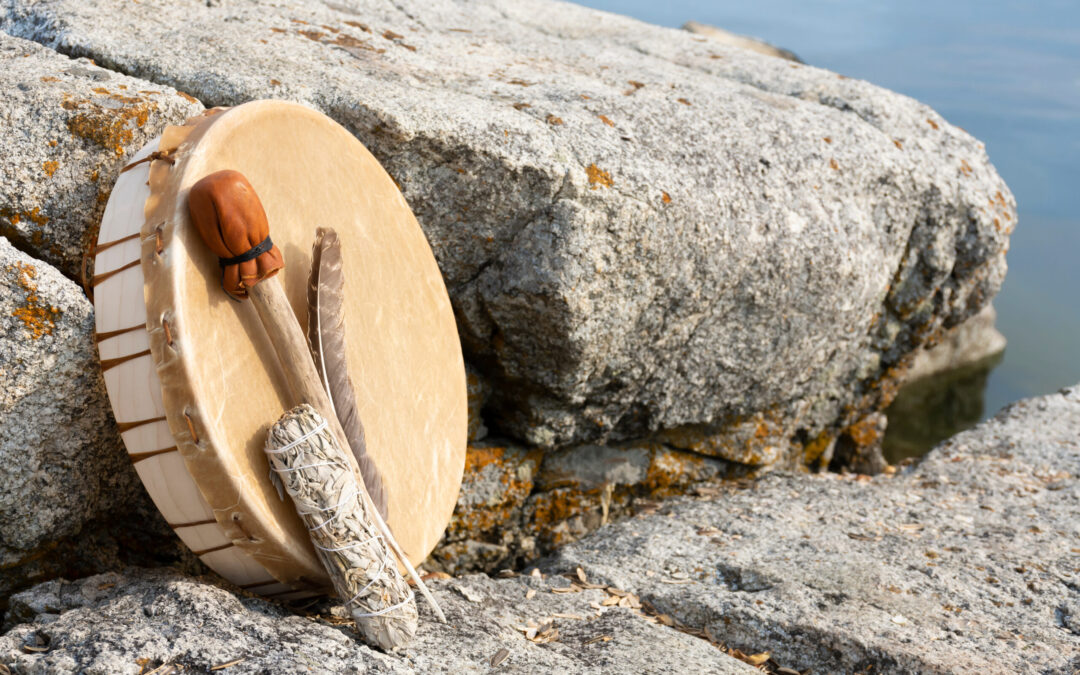
The difference between some shamans from the past and the present day shaman is often witnessed in the lack of sound during their ceremonial healing practice. Whilst many shamans today will still use rattles, drums, herbs, feathers, wands etc., many do not engage in the singing of healing, the chanting of the healing. Traditions show shamans chanting or singing whilst healing. Today, many have lost that art and fail to grasp the true healing power of sound. If you sing or chant whilst your intentions are strongly fixed upon the healing, you are channeling your thoughts through the voice and into the song or chant which vibrates throughout the universe; the ripple may be small, but is heard or felt by all, consciously or unconsciously.
Science Kids states:
- Sound comes from vibration. These vibrations create sound waves which move through mediums such as air and water before reaching our ears.
- Our ears vibrate in a similar way to the original source of the vibration, allowing us to hear many different sounds.
- Dogs can hear sound at a higher frequency than humans, allowing them to hear noises that we can’t.
- Sound is used by many animals to detect danger, warning them of possible attacks before they happen.
- Sound can’t travel through a vacuum (an area empty of matter).
- The speed of sound is around 767 miles per hour (1,230 kilometres per hour).
- The loud noise you create by cracking a whip occurs because the tip is moving so fast it breaks the speed of sound!
- When traveling through water, sound moves around four times faster than when it travels through air.
- The scientific study of sound waves is known as acoustics.
- Although music can be hard to define, it is often described as a pleasing or meaningful arrangement of sounds.
- The sound of thunder is produced by rapidly heated air surrounding lightning which expands faster than the speed of sound.
So in other words, we need vibration and sound and if we can send that vibration via water, it will travel four times faster than if it travels through air. So instead of vibrations traveling at 767 miles per hour, they will be traveling at 3,068 miles per hour. With that in mind, it is hard to say that what comes out of our mouths does not affect the world! If we can accept that although vibrations are not seen by the naked eye unless captured on a monitor or a device they are in fact real, and without them, without vibrations, there would not be any sound. Imagine, a world where we didn’t hear the wind, where we didn’t hear the tiny drops of rain, the rustle of the leaves, the howl of the wolf, the flap of wings, the meow of the cat, the laughter of the baby; vibration is responsible for much of our pleasure in life. So if we can take those vibrations consciously into our healing, we have an amazing power, an amazing gift at our disposal.
The Bible teaches us to speak out that which we wish to create. We can do this via traditional prayer, mantras, singing, speaking; there are so many ways to utilize this gift. We can encourage through talk (vibrations) our clients or patients to speak out that which they desire from their healing.
As bodies that are made up of so much water, does it not stand to reason that as we pray, as we chant or sing, that those same vibrations will transmit themselves through our entire being, traveling faster due to our water content? The amount of water in the human body ranges from 50-75%. The average adult human body is 50-65% water. Infants are around 75-78% water, which drops by the age of one to around 65%. Although these measurements vary according to gender, age, fitness and body composition, in regards to adipose tissue or lean muscle, they still serve to reflect just how much water we are, and just how much amplification we have when vibrating and creating sound. As vibrating beings, does it not stand to reason that perhaps the more we can assist our body to vibrate, or the more we are able to increase our rate of vibration, that we will also be able to intentionally create much faster that which we are trying to heal?
Looking at a growing foetus who is surrounded by water, we can assume that it does sense and later hear the vibration of what the mother is saying, not just what she is feeling; it is thought that a foetus becomes aware of vibration at sixteen weeks’ gestation. With that in mind, it reminds us that during pregnancy we have an optimal time to send vibrations of love and acceptance, of reassurance and compassion to another part of the universe, a growing microcosmic amoebae within.
Many ancient shamanic healing practices are based on using sound to induce certain states of consciousness, or certain trance states in order to precipitate healing. The shaman calls or entices the client’s consciousness into a different state, a state where it can receive, a state where critical thinking is temporarily switched off. The shaman is aware of his power, he knows what he can do from a spiritual perspective, he knows the force behind him and within him, so he can go forth creating with healthy, positive intent. If we look back at the Bible, we can see that Christ commanded the winds to stop, He commanded the seas to calm; now this could be about Christ being God, or it could be about Christ living in recognition of who and what He is or was – a powerful, vibrating being, who could control the weather through intention, vibration, and sound!
From a shamanic perspective, we could still say that Christ spoke to the spirits in connection to the elements and commanded those same spirits to stop and be calm. No matter how we look at it, the message is still the same: we have the power to change the unthinkable, through vibration and sound. Incredible!
We are The Quantum Warrior, The Master Architect of our life – Braveheart